
[ad_1]
So, you’ve acquired your exercise routine all the way down to a science: energy coaching three days every week, cardio twice, mobility work throughout Netflix binges. You’re killing it.
However as a smart coach as soon as mentioned, a exercise is just pretty much as good as your capability to recuperate from it. In case you hit the gymnasium onerous and don’t give equal consideration to relaxation, diet, sleep, and different restoration methods, your exercise gained’t make it easier to get any stronger, quicker, or leaner.
Assuming the largest elements of exercise restoration are in place — diet, stress administration, and sleep — the simplest weapon in your arsenal might be one thing that’s been round for hundreds of years: yoga.
Why Is Restoration Vital?

Virtually from delivery, we’re instructed that train is nice for you. However it’s extra correct to say that the precise dose of train is nice for you: An excessive amount of too quick simply breaks you down.
That’s why it’s worthwhile to relaxation and refuel between exercises. It’s a must to give your physique time to rebuild broken muscle and connective tissue, chill out and de-stress, and forge new neural connections so that you’re stronger and quicker subsequent time you face the weights, the gymnasium, the treadmill, or the monitor.
Relying on the kind of train you do, sure actions (therapeutic massage, chilly immersion, mild cardio exercise) hasten your physique’s return to homeostasis — a balanced, low-stress state — so that you simply’re totally recovered subsequent time you’re employed out.
Yoga is an ideal instance.
How Does Yoga Assist Restoration?
Caveat: Some yoga lessons will be powerful. Do an hour of parallel-depth warrior poses, wheel poses, and inversions, and also you’re not hastening restoration — you’re placing extra stress in your physique.
However different poses make for an ideal restorative observe. Right here’s what an off-day yoga class or temporary, post-workout restorative yoga session can do for you.
1. Improves blood movement
All types of lively restoration have this profit in widespread: “Flushing your tissues with oxygenated blood — mimicking the pumping of the center — is likely one of the finest issues you are able to do for your self while you’re sore and drained,” says bodily therapist Dr. John Rusin.
Instantly after train, you’ll clear away metabolic byproducts that accumulate throughout onerous train. On an off day, you’ll shuttle vitamins into broken tissues that pace therapeutic.
2. Reduces stress
Stress can grind your progress to a halt: By undermining sleep and digestion, it makes restoration out of your exercises infinitely tougher. However yoga is a dependable stress-buster, chilling you out and restoring your nervous system to a muscle-growing, tissue-healing parasympathetic state.
A assessment of analysis discovered that — along with enhancing energy and adaptability, and selling respiratory and cardiovascular operate — yoga lowers stress and anxiousness and improves sleep.
And a research discovered that yoga practitioners rebound from stress extra shortly — not simply emotionally, however metabolically and physiologically — and revel in decrease stress ranges total than non-practitioners.
3. Will increase mobility
Repetitive exercise could cause muscle groups to shorten; sitting, for instance, tightens the muscle groups on the fronts of your hips, whereas pushups do the identical to these of the chest. Decreased joint mobility compromises alignment and joint mechanics, resulting in decreased energy and efficiency and elevated threat of damage.
All of this occurs quicker than you could suppose: “Even after only one exercise, muscle groups can begin to lose elasticity,” says Brent Laffoon, one of many world-class instructors of BODi’s Yoga52. “Over time, this could result in a extra restricted vary of movement within the joints they assist.”
The answer: shifting your joints by way of a full vary of movement — utilizing just a few restoration poses — straight after train or between exercises.
Put up-Exercise Restoration in 4 Yoga Poses
Feeling wrecked after your exercise? End with a calming asana or two. “Restoration poses are simple, non-taxing, and infrequently on the ground,” says Yoga52 teacher Odette Hughes.
For finest outcomes, she says, deal with extending the muscle groups you labored in your most up-to-date exercise. After squats, attempt bridge pose, which stretches the quadriceps. After pushups, attempt youngster’s pose, which opens the chest and shoulders.
New to yoga? Strive the restoration poses under any time for a success of on the spot rest.
1. Downward-facing canine

- Get on all fours, knees straight under your hips, and wrists a few inches in entrance of your shoulders. Unfold your fingers aside broad.
- Tuck your toes, press into your fingers, and elevate your hips up and again. Externally rotate your arms to keep away from shrugging your shoulders, and straighten your arms with out locking your elbows.
- Hold your legs as straight as doable, and your decrease again barely arched. Maintain the pose for 60-120 seconds.
Tip: “Don’t attempt to get your heels to the ground,” says Steven Schilling, a Los Angeles-based yoga and martial-arts teacher. “Suppose as an alternative of pushing your hamstrings again behind you whereas retaining your again in a pure arch.”
2. Seated determine 4
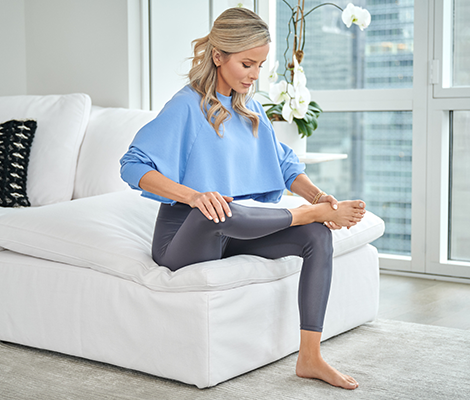
- Sit in a chair together with your again straight and your chest up, ft flat on the ground in entrance of you.
- Raise your proper foot off the ground and place the surface of your proper ankle in your left knee.
- Strongly flex your proper ankle.
- Place your left hand in your proper knee and gently press downward. Maintain for one to 2 minutes and repeat with the opposite leg.
Tip: “Hold pondering sit up as you deal with opening the left hip,” says Schilling.
3. Chest opener

- Stand upright together with your ft hip-width aside.
- Interlace your fingers behind your again whereas retaining your chest lifted.
- Straighten your arms as you gaze towards the ceiling, and maintain for 60 seconds.
Tip: “Squeeze your shoulder blades collectively and elevate your chest,” says Schilling. “Don’t push your head ahead.”
4. Savasana

- Lie flat in your again, enjoyable totally into the ground.
- Unfold your arms out away out of your torso, and switch your palms face up. Separate your ft to hip width or larger.
- Shut your eyes, chill out your jaw, and breathe silently, focusing as particularly as doable on how breath subtly strikes you from head to toe: the light rising and falling of the chest and stomach, the delicate actions within the face, shoulders, arms, and hips.
Tip: “For lots of hard-charging exercisers, that is the toughest pose,” says Schilling. If that’s the case for you, keep there for 60 seconds and work your approach up. Spend a full 5 minutes within the pose and also you’ll rise up feeling like a brand new individual.
[ad_2]
Leave a Reply